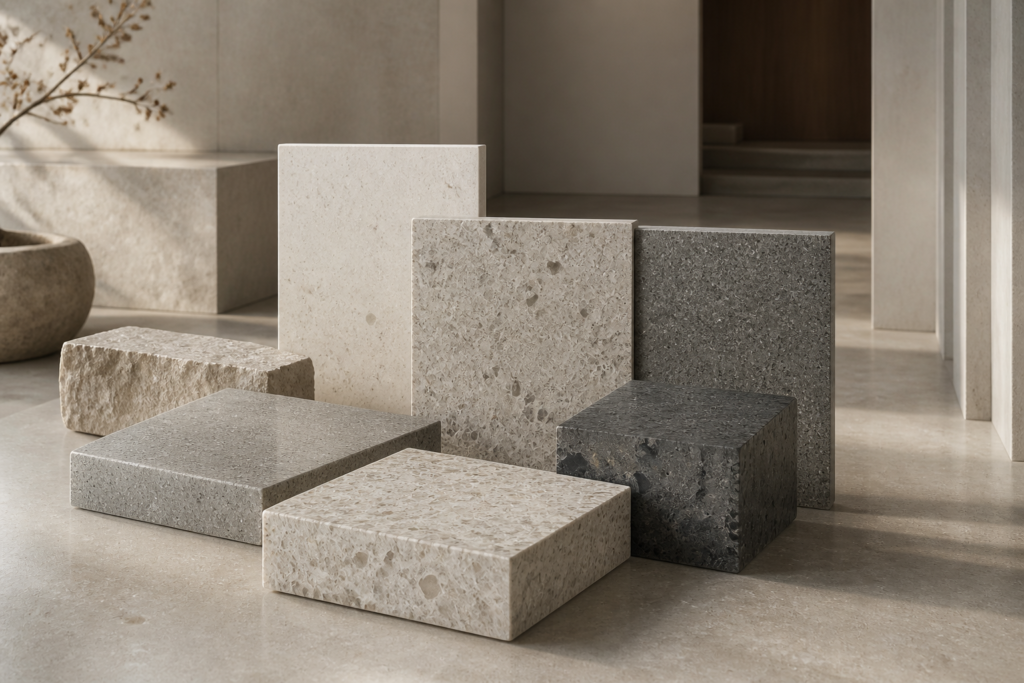
Inorganic stone generally refers to manufactured stone surface materials made primarily from mineral aggregates and an inorganic binder system. Unlike natural stone, it is produced through a controlled manufacturing process. Unlike many resin-based engineered stones, it does not rely on an organic resin as its primary binder.
However, “inorganic stone” is not a universally standardised product name with one identical formulation across every country and manufacturer. Composition, forming method, dimensions and intended applications can vary. A project team should therefore verify the technical data, test basis, samples and installation system rather than specify a material by category name alone.
What is inorganic stone usually made of?
A typical inorganic engineered stone may include:
- mineral aggregates or mineral particles;
- an inorganic binder system;
- additional components used to adjust colour, texture or processing behaviour; and
- a manufacturing sequence that may include forming, curing, cutting and surface finishing.
Products may be supplied as blocks, slabs, panels or other fabricated components. Formulations and processes differ between manufacturers, so information about one product should not automatically be applied to the entire category.
How is inorganic stone different from natural stone?
Natural stone is quarried and then cut and finished. Its colour, veining, porosity and natural features may vary from one block or geological layer to another. Inorganic engineered stone is manufactured from selected ingredients, allowing a producer to exercise a degree of control over colour, aggregate distribution, finish and batch consistency.
This does not mean that a manufactured material is automatically better than natural stone. Suitability depends on the design intent, project location, product format, installation system, budget, maintenance requirements and available technical evidence.
How is inorganic stone different from engineered quartz?
Many engineered quartz products combine quartz particles with a resin binder and are widely used for countertops and interior surfaces. The main distinction is that inorganic stone uses an inorganic primary binder system.
When comparing the two, a specifier should verify:
- the primary binder system;
- the intended location of use;
- temperature, ultraviolet and moisture exposure;
- slab dimensions and support conditions;
- cleaning and maintenance requirements; and
- test reports relevant to the target market.
Is inorganic stone the same as sintered stone?
No. Sintered stone is generally formed by compacting mineral raw materials and processing them at high temperature. Inorganic stone can use different inorganic binding and curing routes. The two categories may both reproduce a stone-like appearance, but their manufacturing mechanisms, structures, formats and installation requirements are not identical.
The terms should not be used interchangeably. When either term appears in a project specification, the project team should confirm the actual product type and supporting documentation.
How does inorganic stone relate to terrazzo?
Terrazzo is a broad material and visual category, usually made from aggregates in a cement-based or resin-based binder and finished to expose the aggregate. Some inorganic stone products may overlap with cement-based terrazzo in material logic, but the categories are not automatically equivalent.
Classification should be based on composition, manufacturing method, applicable product standards and the manufacturer’s documentation—not appearance alone.
Where can inorganic stone be considered?
Depending on the product specification and validation, inorganic stone may be considered for:
- interior wall cladding and feature walls;
- finishes in commercial and public spaces;
- reception areas, corridors and other highly visible zones;
- furniture, countertops or bespoke elements; and
- facade or exterior applications when the product and complete system have been verified for that use.
“May be considered” does not mean that every product is suitable for every location. Facades, high-traffic areas, wet environments, freeze–thaw climates and projects with specific fire requirements require application-specific assessment.
What should architects verify before specification?
1. Product identity
- official product and series name;
- manufacturer and production location;
- basic description of material composition; and
- whether the product is supplied as a slab, panel, tile or another format.
2. Technical documentation
- Technical Data Sheet (TDS);
- Safety Data Sheet (SDS), where applicable;
- dimensions, thickness, tolerances, and unit or area weight, as applicable;
- surface finishes and colour range; and
- installation, cleaning and maintenance instructions.
3. Tests relevant to the intended use
The project team should request tests that match the actual application instead of relying on a general certificate. Facades, interior walls, floors and countertops do not necessarily require the same evidence.
Check whether:
- the product named in the report matches the proposed product;
- the tested specimen matches the intended project format;
- the test method and standard are relevant to the destination market;
- the laboratory, issue date and scope are clear; and
- a result applies to the material alone or to a complete installed system.
4. Samples and batch control
A small sample can help assess colour, texture and finish, but it may not fully represent a large slab, a full block or a production batch. Important projects should agree on sample size, control samples, acceptable variation and batch inspection procedures.
5. The installation system
Material suitability is not determined by the slab alone. Substrate, anchors, adhesives, joints, panel dimensions and site conditions all influence performance. Facades and other higher-risk applications should be assessed by qualified design and engineering professionals as complete systems.
Eight questions to ask an inorganic stone supplier
- What are the principal material components and binder system?
- Where is the product recommended for use, and where is it not recommended?
- Can you provide test reports relevant to the destination market and proposed format?
- What dimensions, thicknesses, tolerances and finishes are available?
- How are colour and texture variations controlled between samples and production batches?
- What installation, cleaning and maintenance methods are recommended?
- Are authorised case studies available for applications comparable to this project?
- How are breakage, replacement orders and batch differences handled?
Frequently asked questions
Is inorganic stone a natural stone?
No. It normally contains mineral components, but it is a manufactured stone material.
Is inorganic stone the same as sintered stone?
No. Both may use mineral raw materials, but their manufacturing processes and product systems differ.
Is inorganic stone always resin-free?
The category name alone is not sufficient evidence. Review the composition statement and manufacturer documentation for the specific product. If a project restricts organic content, request written confirmation and appropriate supporting evidence.
Can inorganic stone be used on a facade?
Some products and systems may be suitable, but the decision must be based on the specific product, project environment, panel format, fixing system and relevant testing.
How should environmental claims be evaluated?
Review raw-material information, production boundaries, third-party certification, an Environmental Product Declaration or other traceable data where available. Words such as “eco”, “green” or “natural” do not by themselves demonstrate environmental performance.
About TRANS HILL Eco-Stone
TRANS HILL Eco-Stone offers inorganic stone surface options and material solutions for architectural and interior projects. Product selection should be completed using formal samples, specifications, technical documents and installation guidance rather than a general website description alone.
When requesting information, provide the destination country, application, dimensions, quantity, finish, installation method and required standards. This helps the supplier confirm which technical documents or sample options, if any, are available for the project.
Conclusion
Understanding inorganic stone is not about memorising a marketing definition. It is about establishing what the material contains, how it is made, where it is intended to be used and what verifiable information the supplier can provide.
For architects and procurement teams, the right questions are often more useful than a broad list of benefits. Define the project conditions, confirm the product identity, review application-specific evidence and assess the material together with its installation system.
Explore Materials and Discuss Your Project
If you are evaluating inorganic stone for an architectural or interior project, review the material collections and project references. To confirm which technical documents or sample options are available for your destination and application, contact the TRANS HILL team. For the next procurement decisions, see how to choose a supply format and the façade material checklist.